有没有"the",意思完全不一样——英语冠词的隐形深坑
(本文解决:中文母语者在使用 prison、school、hospital、church 等场所名词时,不知道何时加 the、何时不加 the 的困惑)
在学习英语的过程中,我们经常把注意力放在背诵复杂的单词或长难句上,却往往容易忽略一些看似微不足道的"小词"——比如定冠词 the。但在某些特定场景下,有没有这个词,表达的意思可能会天差地别。
你是不是也有这些困惑:go to prison 和 go to the prison 有什么区别?go to school 和 go to the school 有什么区别?英语中什么时候名词前不加 the?in hospital 和 in the hospital 有什么区别?如果你正在寻找这些问题的答案,这篇就是你的终极指南。
✍️ 本文由 Aice 英语学习团队编写 · 上海氦铂网络科技有限公司 · 2026-05-21 · 适合 CEFR A2–B2 水平学习者
🎯 核心知识点:有无"the"的本质区别
当 prison(监狱)、school(学校)、hospital(医院)、church(教堂) 等表示特定场所的名词与介词搭配时,是否使用定冠词 the,取决于你前往该场所的目的。
📐 核心规则一句话总结
不加 "the" → 去进行该场所的核心功能活动
例如:去监狱服刑、去学校上学、去医院看病、去教堂做礼拜
加上 "the" → 仅仅去那栋具体的建筑物
例如:去监狱探监/工作、去学校开家长会、去医院看望病人、去教堂欣赏建筑
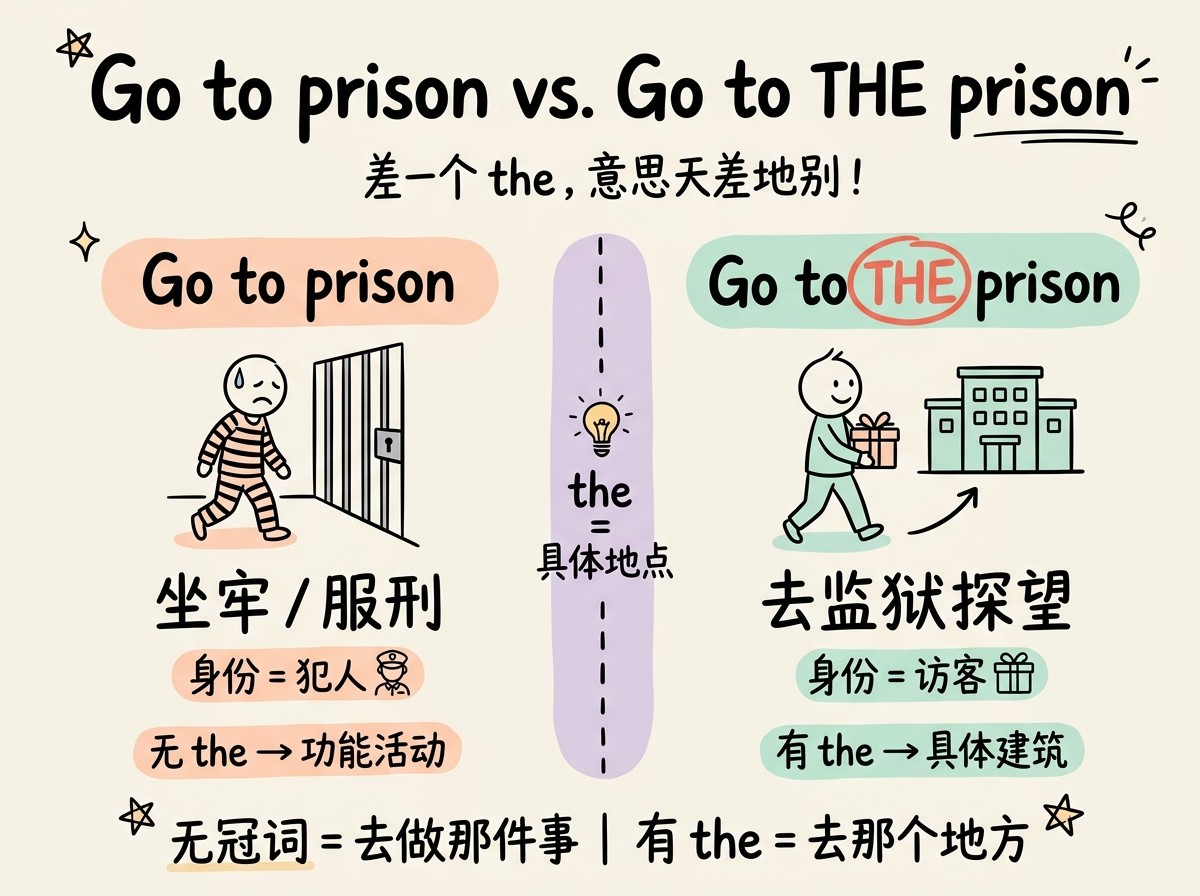
🔍 3组经典对比:一个"the"改变一切
① Go to prison vs. Go to the prison
Go to prison
🔒 去坐牢、服刑(身份:犯人)不加 the,表示去监狱执行其核心功能——服刑。
🌰 He committed a crime and went to prison.
(他犯罪了,所以去坐牢了。)
Go to the prison
🏢 去那所监狱(身份:访客/律师/社工)加上 the,表示去监狱那栋建筑,但不是去服刑。
🌰 I went to the prison to visit an old friend.
(我去了那所监狱探望一位老朋友。)
② Go to school vs. Go to the school
Go to school
📚 去上学、读书(身份:学生)不加 the,表示去学校执行其核心功能——学习。
🌰 My daughter goes to school by bus every day.
(我女儿每天坐公交车去上学。)
Go to the school
🏫 去学校那栋楼(身份:家长/修理工)加上 the,表示去学校建筑,但不是去上学。
🌰 The parents went to the school to meet the principal.
(家长们去学校和校长见面。)
③ Go to bed vs. Go to the bed
Go to bed
😴 去睡觉(进行睡觉活动)不加 the,表示进行"睡觉"这一功能性活动。
🌰 It's late, I think I'll go to bed.
(太晚了,我想去睡觉了。)
Go to the bed
🛏️ 走到床边(针对具体家具)加上 the,表示走向"床"这个具体的家具实体。
🌰 She walked over to the bed and picked up her phone.
(她走到床边,拿起了手机。)
🎬 想看更直观的视频讲解?点击观看冠词用法系列教学视频:
📺 视频讲解:有无 the 的区别🔥 纯正地道表达:6个与本期主题高度相关的 Native 表达
为了让你的英语表达听起来更像母语者,这里整理了6个与冠词误用场景高度相关的地道词汇与短语。
🏆 黄金实战公式(Bonus!)
这个公式适用于雅思口语(IELTS Speaking)第二部分(如"描述一次误会"或"描述一次有趣的经历")以及日常闲聊(Small Talk)。当你想要生动地讲述自己因为语言误会而产生的趣事时,使用这个结构能够让你的表达逻辑严密且充满细节。
场景:别人问你 "Have you ever had a funny language misunderstanding?"
🌟 示范回答
"I remember a funny story from when I first started learning English. I wanted to tell a colleague that I paid a visit to a local correctional facility for a research project. So, I casually said, 'I went to prison.' She looked at me with wide eyes, completely shocked! I didn't realize that missing a simple word like 'the' could get things mixed up so easily. Luckily, I realized my error and quickly explained that I only went to the building to drop off some paperwork. It was a memorable lesson that taught me how a tiny grammatical slip can change your status from a simple visitor to someone doing time!"
📝 中文翻译:"我记得刚开始学英语时发生过一件趣事。当时我想告诉同事,我因为一个研究项目去拜访了当地的一所监管机构。于是我很随意地说了句:'I went to prison(我去坐牢了)'。她睁大眼睛看着我,彻底惊呆了!我当时完全没有意识到,漏掉一个像 'the' 这样简单的词会把事情弄混到这种程度。幸运的是,我及时发现了错误,并赶紧解释说我只是去那栋大楼送点文件。这是一次难忘的教训,它让我明白,一个微小的语法失误,就能把你的身份从一个普通的访客变成正在服刑的犯人!"
💡 公式解析:
· A(背景铺垫):通过引入 "paid a visit to a local correctional facility" 交代了真实背景,使用地道词汇建立高级感。
· B(语言误会):巧妙地运用了 "get things mixed up",直观展现了有无冠词产生的戏剧性效果。
· C(结局与感悟):用 "drop off some paperwork" 解释了实际行为,并用 "doing time" 与开头的误会形成幽默对比,使整个故事逻辑闭环。
📖 增值拓展:更多需要注意的冠词细节
除了前面提到的 prison、school、bed,还有几个高频词汇在搭配冠词时也存在类似的细微差别:
1. Go to church vs. Go to the church
Go to church 指去教堂做礼拜(宗教活动)。
Go to the church 指去教堂那栋建筑(可能只是去欣赏建筑风格,或者去修水管)。
2. Go to university/college vs. Go to the university/college
Go to university 指在上大学(身份是大学生)。
Go to the university 指去大学校园(比如去大学里找人或参观)。
3. In hospital vs. In the hospital(注意英美差异)
在英式英语中,in hospital 专指生病住院,而 in the hospital 指在医院大楼里。
但在美式英语中,即使是住院,人们也经常习惯说 in the hospital。
💡 遵循"无冠词表示功能,有冠词表示地点"这一基本规律,依然能帮助你在绝大多数英语国家进行准确的交流。
🧩 来个小测试,看看你掌握了没有
你想说"他因为犯罪被关进了监狱",以下哪种表达正确?
A. "He was sent to the prison." B. "He was sent to prison." C. "He was sent to a prison."
✅ 答案:B — "He was sent to prison." 不加 the,表示去监狱服刑(核心功能)。A 的 the prison 暗示只是去那栋建筑。
你想说"家长们去学校参加家长会",哪种说法正确?
A. "The parents went to school for the meeting." B. "The parents went to the school for the meeting."
✅ 答案:B — "The parents went to the school for the meeting." 家长不是去上学,而是去学校那栋建筑开会,所以要加 the。
"太晚了,我该去睡觉了"用英语怎么说?
A. "It's late, I should go to the bed." B. "It's late, I should go to bed."
✅ 答案:B — "I should go to bed." 不加 the,表示进行"睡觉"这一活动。go to the bed 是走到床这个家具旁边。
"她每周日都去教堂做礼拜"用英语怎么说?
A. "She goes to the church every Sunday." B. "She goes to church every Sunday."
✅ 答案:B — "She goes to church every Sunday." 不加 the,表示去教堂进行其核心功能——做礼拜。
✨ 简单小结
| 不加 the | 含义 | 加 the | 含义 |
|---|---|---|---|
| go to prison | 去坐牢 | go to the prison | 去监狱(探望/工作) |
| go to school | 去上学 | go to the school | 去学校(开会/修理) |
| go to bed | 去睡觉 | go to the bed | 走到床边 |
| go to church | 去做礼拜 | go to the church | 去教堂建筑 |
| go to university | 在上大学 | go to the university | 去大学校园 |
| in hospital (英式) | 住院 | in the hospital | 在医院大楼里 |
记住核心规则:无冠词 = 功能活动,有冠词 = 具体建筑。掌握这一点,你就能轻松避开这些隐形深坑!💪
收藏这篇指南,别让一个小小的 "the" 改变了你的人生身份!🌟
对于中文母语的英语学习者,冠词是最容易被忽视却最容易出错的语法点之一。中文没有冠词系统,所以我们很难直觉地感受到 the 的有无对含义的影响。但只要记住"功能 vs 建筑"这一核心逻辑,你就能在口语和写作中精准使用这些表达。
常见问题解答
Q: go to prison 和 go to the prison 有什么区别?
一句话答案:go to prison 意为"去坐牢、服刑",身份是犯人;go to the prison 意为"去那所监狱",身份是访客、律师或社工。核心规则:不加 the = 功能活动,加 the = 具体建筑。
Q: go to school 和 go to the school 有什么区别?
一句话答案:go to school 意为"去上学",身份是学生;go to the school 意为"去学校那栋建筑",比如家长去开会。
Q: go to bed 和 go to the bed 有什么区别?
一句话答案:go to bed 意为"去睡觉",指进行睡觉活动;go to the bed 意为"走到床边",指针对床这个具体家具。
Q: 英语中什么时候名词前不加 the?
一句话答案:当 prison、school、hospital、church 等场所名词与介词搭配时,不加 the 表示去该场所进行其核心功能性活动。加上 the 则仅表示去那栋具体的建筑物。
Q: in hospital 和 in the hospital 有什么区别?
一句话答案:英式英语中 in hospital 专指住院,in the hospital 指在医院大楼里。美式英语中即使住院也常说 in the hospital。
Q: do time 是什么意思?
一句话答案:do time 是非正式口语表达,意为"服刑、坐牢",等同于 serve a prison sentence。例如:He did some time in his youth.(他年轻时坐过牢。)
📖 本文适用场景:雅思口语 Part 2 关于"描述一次误会/有趣经历"话题备考、英语语法冠词专项学习、想要避免 go to prison / go to the prison 等冠词误用的中文母语英语学习者、想了解英语零冠词规则的学习者。